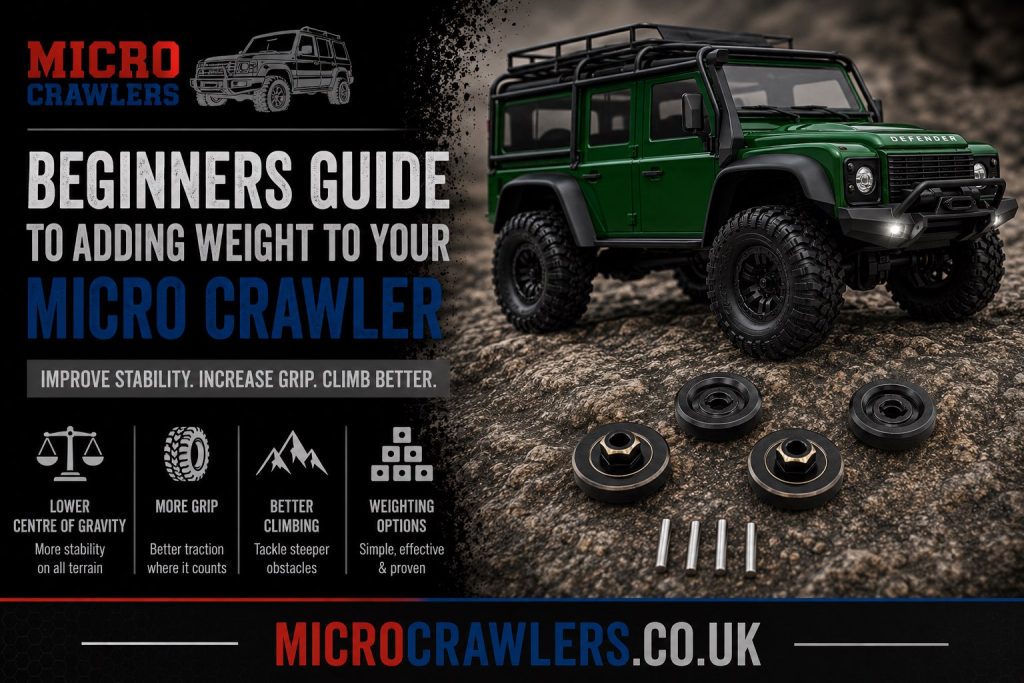

Micro crawlers have a way of getting under your skin quickly. You pick up something the size of your hand — a 1/24 scale Axial SCX24, maybe, or a Traxxas TRX-4M — and within about ten minutes of watching it inch its way over a rock in your back garden, you’re already wondering what you could do to make it better. That itch to tinker is part of the hobby. But it’s worth pausing before you start clicking “add to basket” on a pile of brass and alloy parts.
This guide is aimed at anyone who’s just got into micro crawlers or recently picked up a new rig and wants to know which upgrades are actually worth making — and which ones will just cost you money without much return. We’ll cover the best first micro crawler upgrades in priority order, talk through weight distribution, and flag the most common mistakes people make when they start modifying. The short version: learn your rig first, then upgrade with purpose.
Before You Spend Anything
The Pros and Cons of Upgrading
Best First Upgrades for Micro Crawlers
Getting Your Weight Distribution Right
Mistakes to Avoid
Final Thoughts
Table Of Contents
- Before You Spend Anything
- The Pros and Cons of Upgrading
- Best First Upgrades for Micro Crawlers
- Getting Your Weight Distribution Right
- Mistakes to Avoid
- Final Thoughts
Before You Spend Anything
This might sound counterintuitive in an article about upgrades, but the most useful thing you can do when you get a new micro crawler is run it stock for a while. Not an afternoon — a proper few sessions, on real terrain if you can manage it.
The reason is straightforward: you can’t diagnose what needs fixing if you don’t know how the rig actually performs. Does it want to flip backwards on steep climbs? Is it sliding sideways on a side-hill rather than tracking? Are the tyres spinning uselessly on smooth rock? Each of those symptoms points to a different solution. If you go straight in with a basket full of parts, you’re guessing — and this hobby rewards patience over spending.
Stock micro crawlers are designed to a price point, which does mean compromises. But they’re not useless out of the box. The 1/24 and 1/18 scale platforms from the likes of Axial, FMS, and Traxxas are genuinely capable little rigs, and understanding their limitations through actual use makes every upgrade you make after that more deliberate and effective.
The Pros and Cons of Upgrading
It’s worth being honest about this because the upgrade rabbit hole in micro-crawling is deep and can get expensive.
The case for upgrading
- Reliability: Some stock parts — particularly plastic-geared steering servos — are a known weak point and will fail under load. Replacing those makes practical sense early on.
- Performance gains: A well-tuned micro crawler can handle inclines of 45 to 55 degrees. A stock rig may struggle above 35–40 degrees. That’s a meaningful difference if you want to push the vehicle.
- It’s part of the fun: Building and tuning is genuinely enjoyable for a lot of people. There’s real satisfaction in getting the weight distribution dialled in and watching the rig walk up something it couldn’t manage before.
The case for restraint
- Diminishing returns: The first two or three upgrades tend to make the biggest difference. After that, you can spend a lot chasing marginal gains.
- Wrong upgrades can make things worse: Loading up a micro crawler with aluminium parts in the wrong places can actually raise the centre of gravity and make it less stable. More on that later.
- Cost adds up fast: Brass knuckles, beadlock wheels, a new servo, sticky tyres — individually they seem modest, but it mounts up. Know what you’re trying to fix before you buy.
Best First Upgrades for Micro Crawlers
Right, assuming you’ve had a few runs with the stock rig and you’ve got a feel for what it’s doing, here are the upgrades worth considering — roughly in the order I’d recommend tackling them.
1. High-Torque Metal-Gear Steering Servo
If you only ever do one upgrade, make it this one. The stock plastic-geared micro servo is the single most common failure point on entry-level micro crawlers. Get the front tyres caught between two rocks, apply a bit of steering lock, and you’ll hear the gears strip. It’s not a matter of if — it’s when.
A metal-gear, high-torque replacement servo solves that immediately. For the SCX24, the EMAX ES08MAII is a popular and well-regarded option. It’s not expensive, the swap is straightforward, and you’ll notice the difference in steering response as well as durability. If you’re running larger aftermarket tyres, a stronger servo becomes even more important — the added rolling resistance puts real strain on those stock gears.
2. Brass Weighted Parts (Front-End First)
This is where micro crawler upgrades really come into their own. Replacing plastic components with brass equivalents adds unsprung weight — weight that sits below the suspension and isn’t fighting your ride quality. It directly lowers the centre of gravity (CG), which is the main reason stock micro crawlers can feel top-heavy and tippy on side-hills.
The key here is where you add the brass, and in what order. The most effective locations are:
- Front steering knuckles: Adds weight right at the front axle and keeps the front tyres planted on climbs. Start here.
- Portal covers: If you’re running a portal-axle rig like the TRX-4M or FMS FCX24, brass portal covers are excellent — they add weight at the very lowest point of the drivetrain. Adding brass portal covers to a TRX-4M typically adds 70–100 grams to the axle, which makes a noticeable difference to side-hill stability.
- Diff covers: Adds weight to the centre of each axle. Useful once you’ve sorted the front end.
The principle is simple: add brass incrementally, test on a slope after each addition, and only add more if the rig is still showing the same problem. You don’t need to brass-up every single component — just enough to get the balance right. Understanding unsprung weight and how it affects your build is genuinely one of the more satisfying rabbit holes in this hobby once you get into it.
3. Beadlock Wheels and Sticky Tyres
Stock tyres on most micro crawlers are made from a harder rubber compound. Hard-wearing, yes — but not designed for grip on real rock or mixed terrain. Aftermarket options from brands like Injora, RC4WD, and Pro-Line use softer, stickier compounds that conform far better to uneven surfaces.
Pairing those with beadlock wheels is the sensible move. Unlike standard wheels that rely on glue to hold the tyre to the rim, beadlock wheels use a bolt-on outer ring to clamp the tyre in place. That means easy tyre swaps, easy foam insert changes, and the ability to add small internal weights to the wheel without any drama. Most 1/24 micro crawlers use 1.0-inch wheels, so there’s a reasonable range of aftermarket options available.
One extra tip worth mentioning: vent your tyres. A small hole in the sidewall allows air to escape when compressed, which lets the foam inside do its job properly and helps the tread wrap around rock faces rather than bouncing off them. It sounds fiddly but it genuinely works.
4. High-Clearance Suspension Links
Stock suspension links are straight — which is fine for flat ground, but a real problem on technical terrain, where rocks can catch the underside of the links and lift the wheels off the surface entirely. This is called high-centring, and it’s one of the most frustrating ways to get stuck.
High-clearance links are bent upward at the centre, creating more space between the link and the ground. It’s not a dramatic performance upgrade in the same way as brass or stickier tyres are, but on technical crawling courses, it makes a real practical difference. If you find your rig getting beached on rocks mid-traverse, this is the fix. Setting up your micro crawler for technical terrain is worth a read once you start pushing the rig a bit harder.
Getting Your Weight Distribution Right
This is the part of micro crawler tuning that people often skip, and it’s a shame because it’s one of the most effective things you can do — and it costs nothing if you’ve already got the brass fitted.
The target for performance crawling is a 60% front / 40% rear weight split. That forward bias keeps the front tyres pressing into the terrain on steep climbs rather than lifting away. Here’s a simple way to find where you are:
- Establish a baseline. Test the stock rig on a 45-degree incline. Note whether it flips backwards (needs more front weight) or whether it’s sliding sideways (tyre grip issue).
- Weigh front and rear separately. Pop the rig onto two small kitchen scales — one under the front tyres, one under the rear. Do the maths to work out your current percentage split.
- Lower and move the battery. If the battery is mounted high on the chassis, using Velcro or a simple 3D-printed tray to drop it lower and shift it slightly forward can make a noticeable difference before you’ve added a single brass part.
- Add brass incrementally from the front. Start with the front steering knuckles, re-test the incline, and only add more if the front is still lifting. There’s no need to keep piling on weight once the balance is right.
It’s methodical, but that’s the point. Getting the weight balance right on a scale crawler is one of those fundamentals that pays dividends across everything else you do with the rig.
Mistakes to Avoid
A few things that catch people out, especially when they’re new to micro crawler upgrades. Worth knowing before you start spending.
Over-weighting the rear
Adding brass to the rear axle might seem like it’d improve traction at the back, but on a steep climb, it actually works against you — it pulls the rig rearward and makes the front tyres even more likely to lift. Keep the brass up front, particularly when you’re starting out.
Going all-in on aluminium
An all-aluminium build looks impressive, but replacing every plastic component — frame rails, transmission housings, the lot — with alloy parts often adds sprung weight in the wrong places, raising the CG and making the rig more prone to rolling over on side-hills. Aluminium isn’t a problem in itself; it just needs to go in the right places. Brass low down beats aluminium high up, every time.
Over-tightening wheel nuts
On micro-scale hardware, it’s surprisingly easy to do this. Over-tightening compresses the bearings, causes binding, and puts unnecessary strain on the motor. Wheel nuts want to be just snug — not cranked down.
Forgetting threadlock
Metal-to-metal screws — like those holding brass knuckles in place — will vibrate loose over time. A tiny drop of blue (removable) threadlock on the thread solves that. Just don’t use it on screws going into plastic, or you’ll regret it the next time you need to disassemble anything.
Final Thoughts
Micro crawlers are a brilliant corner of the RC hobby — tactile, technical, and genuinely satisfying to tune well. The upgrade path doesn’t have to be complicated or expensive, as long as you approach it with a bit of method.
Run it stock first. Learn what it’s actually doing. Then address the real weak points in order: servo reliability, brass weight up front, stickier tyres on beadlocks, high-clearance links if you’re going technical. Get the 60/40 weight split as close as you can, and you’ll have a rig that punches well above its size.
After that? Well, there’s always brushless conversions, LCG chassis builds, and silicone tyre foam inserts to explore if you catch the bug properly. But that’s a whole other conversation. Exploring brushless upgrades for scale crawlers is worth bookmarking for when you get there. For now, get out and drive the thing — that’s where the fun actually is. Let us know how you get on.